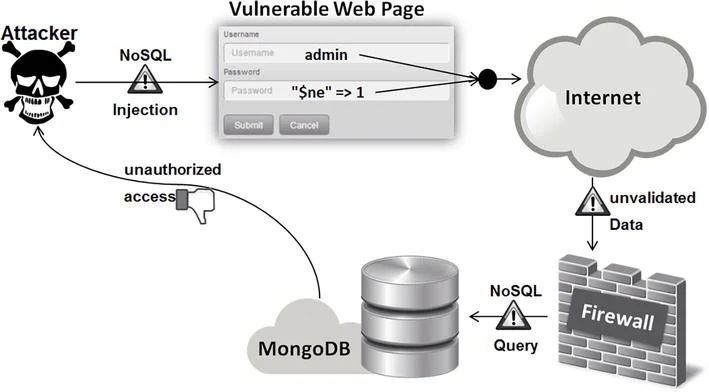

Advanced NoSQL Injection: A Comprehensive Practitioner's Guide to Exploitation, Bypasses, and Strategy
The Paradigmatic Shift in Database Architectures and the Injection Illusion
The foundational architecture of modern enterprise web applications has undergone a radical transformation over the past decade, driven by the insatiable demand for horizontal scalability, high-velocity data ingestion, and schema flexibility. Traditional Relational Database Management Systems (RDBMS), constrained by rigid relational tables, strict schemas, and the declarative Structured Query Language (SQL), have increasingly been augmented or replaced by non-relational alternatives. These NoSQL (Not Only SQL) databases encompassing document stores like MongoDB and CouchDB, graph databases like Neo4j, key-value stores like Redis, and wide-column stores like Cassandra and Google Bigtable prioritize dynamic data handling and developer velocity.
However, this architectural migration has inadvertently cultivated a pervasive and dangerous psychological blind spot within the software engineering community: the misconception that the absence of a traditional SQL parser inherently immunizes an application against injection vulnerabilities. The reality is demonstrably the opposite. NoSQL injection (NoSQLi) represents a critical and highly exploitable security vulnerability that manifests when web applications process untrusted, unsanitized user input within non-relational database queries.
Because NoSQL databases do not adhere to a single standardized query language, the execution environment, syntax, and grammatical structures are highly product-specific and frequently rely on procedural programming languages, most notably JavaScript.
This fundamental architectural difference means that while traditional SQL injection payloads (such as UNION SELECT or ' OR 1=1 --) will categorically fail against a MongoDB instance due to syntactic incompatibility, the underlying mechanism of injection subverting data into executable code remains fully viable and often far more destructive.
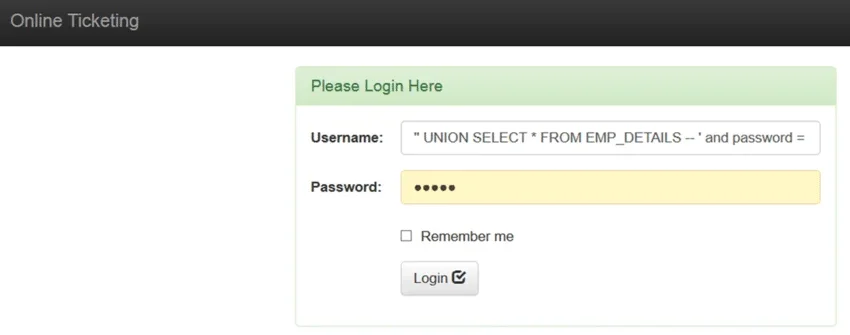
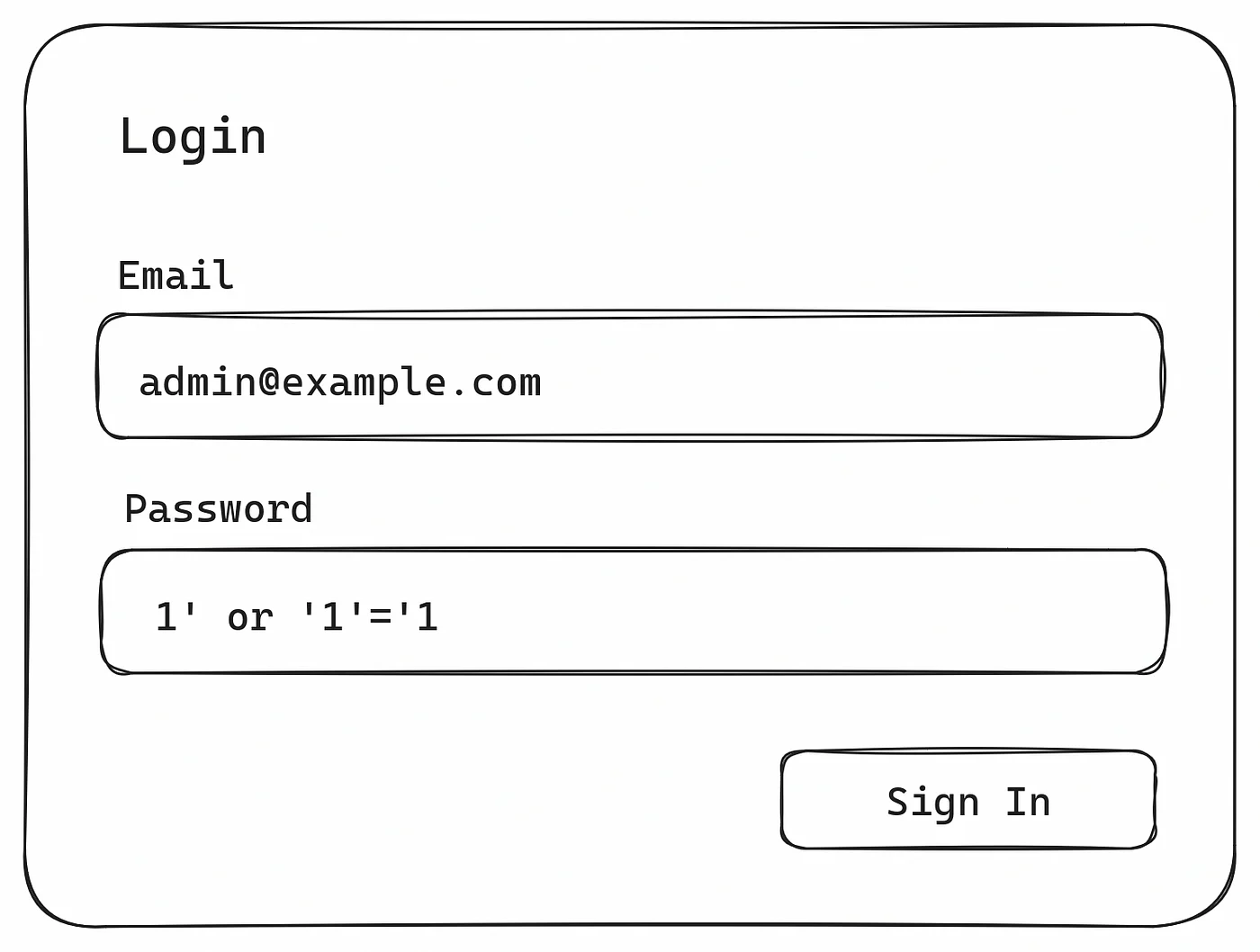
These are the examples of UNION SELECT or ' OR 1=1 -- usages.
The severity of NoSQL injection frequently eclipses that of traditional SQL injection due to the execution layers involved. Whereas traditional SQL injection executes exclusively within the isolated confines of the database engine, NoSQL variants possess the capability to execute at both the database layer and the application layer. Depending on the specific NoSQL Application Programming Interface (API), the Object-Document Mapper (ODM), and the data model in use, an attacker can manipulate the very application code that parses, evaluates, or concatenates the attack string. This multi-layered execution environment allows malicious payloads to leverage the power of the application's native runtime, making the total compromise of the application layer, denial of service, and full server hijacking frequent corollaries to NoSQL database manipulation.
Furthermore, standard application security sanitization frameworks designed to neutralize SQL injection are routinely rendered useless against NoSQL attacks. Traditional defenses prioritize the filtering or escaping of common HTML and SQL special characters, such as the less-than sign (<), greater-than sign (>), ampersand (&), and semicolon (;). However, the primary attack vector for modern NoSQL databases is the JavaScript Object Notation (JSON) format, which relies entirely on a different set of syntactic operators, including curly braces ({, }), colons (:), brackets ([, ]), and dollar signs ($). When security filters fail to account for JSON syntax, untrusted parameters pass seamlessly into the database driver, leading to critical logic subversion and unauthorized data access.
Execution Layers and the Anatomy of Non-Relational Queries
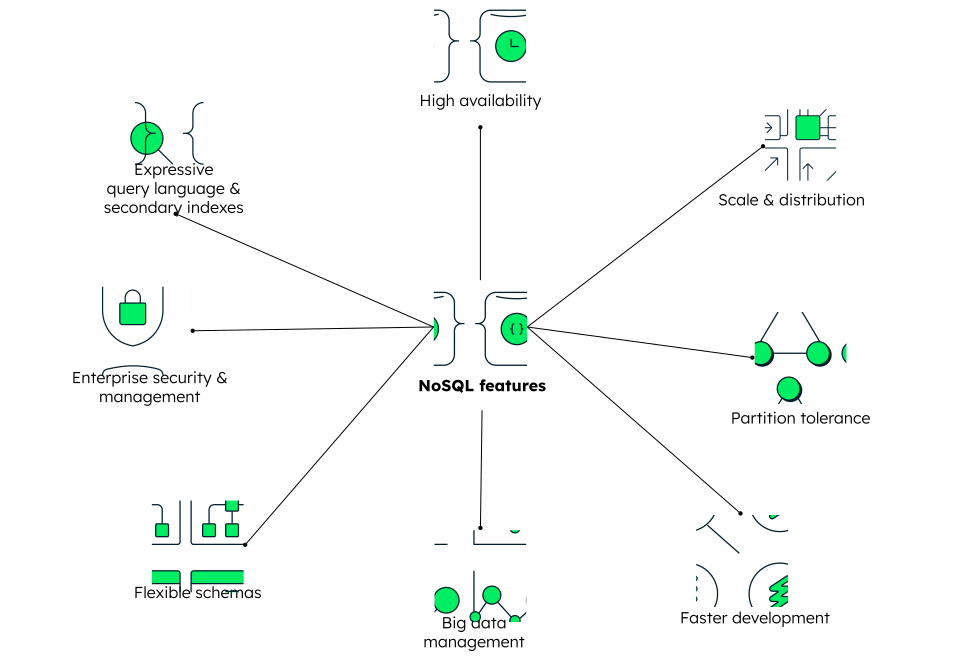
To successfully identify and exploit NoSQL vulnerabilities, advanced bug bounty hunters and penetration testers must possess a granular understanding of the specific execution layers where these attacks materialize. The flow of data from an HTTP request to a NoSQL database engine is highly complex and heavily abstracted by modern web frameworks.
In a typical NoSQL architecture, data access is mediated by a software driver written in the application's native programming language (e.g., Node.js, Python, PHP, or Go). These drivers are responsible for translating the application's data structures into the specific wire protocol understood by the database. Even when the drivers themselves are cryptographically secure and free of memory corruption vulnerabilities, they frequently expose insecure APIs that allow for arbitrary code execution if the developer fails to implement them safely.
The attack surface is highly dependent on the specific NoSQL engine and the query mechanism it employs.
Database Engine | Architecture Classification | Primary Query Mechanism | Key Injection Vectors and Vulnerable Constructs |
|---|---|---|---|
MongoDB | Document Store | BSON / JSON / JavaScript | Operator injection ( |
Neo4j | Graph Database | Cypher Query Language | Clause injection ( |
Redis | Key-Value Store | CLI / Custom Protocol | Command injection, Lua script manipulation |
CouchDB | Document Store | REST HTTP API / JSON | MapReduce script injection, JSON manipulation |
Elasticsearch | Search Engine / Document Store | JSON-based Query DSL | Query string manipulation, dynamic script evaluation |
When an application accepts user input formatted according to a common convention (such as XML, JSON, or LINQ) and parses it directly into a NoSQL API call, it bypasses traditional string-matching defenses. This is particularly lethal in environments utilizing MongoDB, which constructs queries using Binary JSON (BSON) objects. Because MongoDB queries are structured as key-value pairs rather than concatenated raw strings, the injection does not typically break out of a string literal, but rather injects an entirely new object containing reserved database operators that fundamentally alter the mathematical and logical constraints of the query.
Core Exploitation Modalities: Syntax versus Operator Injection
The exploitation of NoSQL databases is fundamentally divided into two distinct strategic modalities: Syntax Injection and Operator Injection. An advanced practitioner must seamlessly pivot between these methodologies depending on how the target application handles user-supplied input, its type-casting mechanisms, and the underlying database dialect.
The Mechanics of NoSQL Syntax Injection
Syntax injection occurs when an attacker provides input that successfully breaks the intended structural syntax of the NoSQL query, enabling the concatenation or execution of a custom payload. The methodology closely mirrors that of traditional SQL injection, requiring the attacker to escape the current context, inject malicious logic, and gracefully terminate or comment out the remainder of the legitimate query.
Practitioners typically identify syntax injection vulnerabilities by systematically fuzzing every input parameter with a battery of special characters designed to trigger unhandled database engine exceptions or observable behavioral anomalies. If the application does not properly sanitize these inputs, the database will return an error or alter its output, confirming a viable injection path.
A highly effective fuzzing string specifically engineered for MongoDB environments incorporates a multitude of context-breaking characters: '"\{ ;$Foo} $Foo \xYZ. When URL-encoded to survive HTTP transmission and WAF normalization, this payload materializes as: %27%22%60%7b%0d%0a%3b%24Foo%7d%0d%0a%24Foo%20%5cxYZ%00. The inclusion of single quotes ('), double quotes ("), curly braces ({, }), semicolons (;), and line feeds (\n, \r) systematically tests every possible escaping requirement within a JavaScript evaluation context.
Furthermore, if an application implements a custom security filter that validates the beginning of a string but fails to account for memory management nuances, attackers can utilize null character injection (%00) to force the database engine to truncate subsequent restrictions. For instance, if an application applies a server-side visibility check appending && this.released == 1 to a query, an attacker injecting category=fizzy'%00 forces the parser to ignore the visibility constraint entirely, effectively rendering hidden, unreleased, or restricted data accessible. Similarly, attackers can override logical conditions by injecting tautologies such as '||'1'=='1, which, when URL-encoded as %27%7c%7c%27%31%27%3d%3d%27%31, forces the boolean expression to evaluate to true, bypassing the intended filter.
The Dynamics of NoSQL Operator Injection
Operator injection represents a significantly more insidious threat vector, unique to NoSQL environments that support complex, object-based query structures. This occurs when an attacker manipulates the JSON structure of an HTTP payload or leverages HTTP Parameter Pollution in URL parameters to introduce native NoSQL query operators, thereby completely subverting the query's internal logic without technically breaking the syntax.
This attack is most devastating in MongoDB environments where applications process user-controlled JSON and pass it directly to the database driver without strict type enforcement.
Operator | Functional Description | Exploitation Context and Strategic Impact |
|---|---|---|
| Not Equal | Universally used to bypass exact match requirements, primarily resulting in catastrophic authentication bypasses and horizontal privilege escalation |
| Regular Expression | Weaponized to extract sensitive data character-by-character via blind boolean pattern matching when application output is suppressed |
| Greater Than / Less Than | Exploited to enumerate numerical boundaries, leak financial data, or bypass empty string validation checks by targeting null values |
| In Array / Not in Array | Utilized to expand query scope to match multiple arbitrary values, often leaking lists of hidden product IDs or user roles |
| JavaScript Execution | The most dangerous operator, allowing for full Server-Side JavaScript Execution (SSJI), data exfiltration, and resource-exhaustion Denial of Service attacks |
| Expression / Scheme Validation | Advanced operators that allow internal referencing of variables and aggregation expressions within standard query languages, creating complex logic bypasses |
When frameworks accept loosely typed inputs, the raw JSON containing these operators is processed directly. For example, if an attacker submits ?username[$ne]=invalid in a URL parameter, and the backend Node.js Express framework parses this into the object {"username": {"$ne": "invalid"}}, the database will process the $ne operator natively, bypassing any string-based sanitization because the input is no longer a string, but a nested operational object.
Real-World Attack Scenarios and Advanced Payloads
To comprehend the severity and practical application of NoSQL vulnerabilities, it is necessary to examine complex attack vectors utilized in high-stakes penetration testing, red team engagements, and bug bounty hunting. The exploitation sequences frequently evolve from simple logic subversion to full infrastructure compromise.
Authentication Bypass via Operator Injection
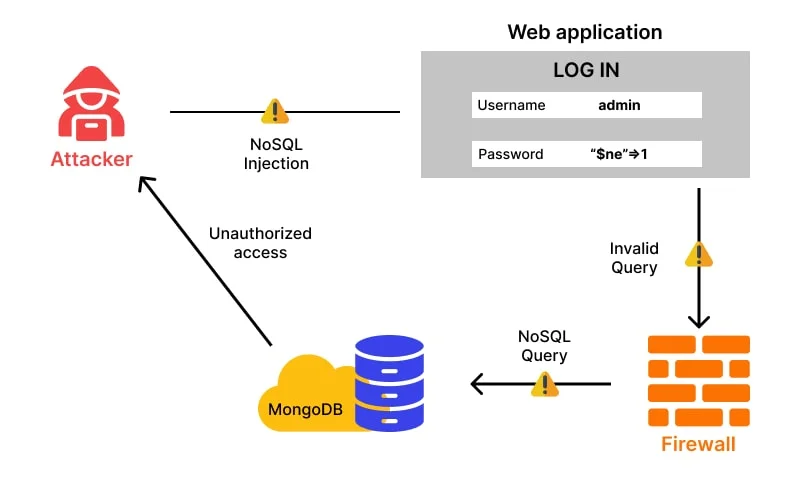
The most universally recognized and rapidly executable impact of NoSQL operator injection is the authentication bypass. When an application constructs a user authentication query by passing user-controlled parameters directly into a document filter, attackers can utilize the $ne (not equal) operator to systematically circumvent credential validation without possessing any valid credentials.
Consider a backend authentication query intended to validate a user's session: db.users.find({ email: "[email protected]", password: "password" });
If the application is configured to accept JSON payloads in the HTTP POST body and fails to enforce strict type checking on the incoming data, an attacker can manipulate the request structure. Instead of providing a string for the email and password, the attacker submits the following JSON object: {"email": {"$ne": "[email protected]"}, "password": {"$ne": "wrongPassword"}}.
When the database engine evaluates this query, it searches the users collection for any document where the email address is not "[email protected]" and the password is not "wrongPassword". Because this negative condition is mathematically true for the vast majority of entries in the database, the engine returns a cursor pointing to the first matched record it encounters. The application, receiving a valid user record from the database driver, assumes authentication was successful and logs the attacker in as the first user in the database collection—which is almost exclusively the primary system administrator.
A real-world manifestation of this exact vulnerability was documented in the Aquila CMS (CVE-2024-48573). The application's password reset functionality utilized a findOne database function that processed a user-supplied token parameter without invoking the necessary sanitizeFilter function. By injecting the $ne operator into the token parameter via the web interface, an unauthenticated attacker could completely bypass the cryptographic token check. The database returned the first user record it found, allowing the attacker to forcefully reset the password of the administrative account and seize control of the CMS infrastructure.
Server-Side JavaScript Injection (SSJI)
Certain NoSQL engines, most notably MongoDB, support the evaluation of raw JavaScript within their queries to handle complex filtering logic that standard query operators cannot mathematically accommodate. This powerful functionality is accessed via the $where operator. If an attacker can manipulate the input passed to a $where clause, or force the creation of one, they achieve Server-Side JavaScript Injection (SSJI), effectively turning the database engine into an arbitrary code execution environment.
An application might implement a legitimate query calculating user balances by evaluating fields within the same document: db.myCollection.find( { $where: function() { return obj.credits - obj.debits < 0; } } );.
In PHP environments utilizing MongoDB, attackers can exploit HTTP Parameter Pollution to introduce arbitrary variables into the application context. Because MongoDB natively accepts $where as a valid query operator and PHP concurrently allows $where as a standard variable name, an attacker can contaminate HTTP parameters to force a collision. By sending a parameter such as ?username[$where]=..., the attacker replaces the intended logic with a malicious JavaScript payload.
The attacker can then force the evaluation of an always-true condition combined with arbitrary code execution by injecting a logical bypass:
`this.username === "" |
| true | | ""=="". This payload utilizes the logical OR (||) condition to make the expression always return True`, bypassing any surrounding logic and forcing the database to return all records.
Boolean-Based Blind Data Exfiltration and Binary Search Algorithms
When an application is vulnerable to NoSQL injection but securely handles its presentation layer—meaning it does not directly return the database query output to the user interface—practitioners must rely on blind, boolean-based data exfiltration techniques. This sophisticated methodology is achieved by utilizing the $regex operator or JavaScript's native match() function to ask the database engine a series of true/false questions about the underlying data.
If an attacker seeks to steal an administrator's session token, API key, or password, they can inject a regular expression pattern that systematically iterates through the entire character set. The base payload structure often resembles: {"username":"admin","password":{"$regex":"^a.*"}}.
The database evaluates the regular expression to determine if the string associated with the password field begins with the letter "a". If the condition is true, the application's HTTP response will indicate success (e.g., returning an HTTP 200 OK, a slightly larger content length, or successfully loading a user profile). If false, the application will return a failure state. By observing these microscopic differences in the HTTP response, the attacker confirms the first character. This process is iterated programmatically (e.g., testing ^b.*, ^c.*, then progressing to ^ad.*, ^ae.*) until the entire cryptographic string is exfiltrated across the network.
In a professional bug bounty context, performing linear extraction of a 64-character token is highly inefficient and creates excessive network noise. To optimize extraction and evade rate limiting, practitioners utilize binary search algorithms within their injection scripts, asking questions such as "Is the first character's ASCII value greater than 77?" ({"$regex": "^[N-Z].*"}). This reduces the time complexity of the extraction from linear $O(n)$ to logarithmic $O(\log n)$, significantly decreasing the number of required HTTP requests.
Furthermore, if the underlying database schema is unknown to the attacker, they can exfiltrate the actual names of the database fields themselves by utilizing JavaScript object mapping. By injecting a payload such as "$where":"Object.keys(this).match('^.{0}a.*')", the attacker iterates through the keys of the document object, mapping the database structure dynamically to locate sensitive fields like ssn, credit_card, or 2fa_secret. If the passwords extracted are hashed, the attacker captures the hashes and utilizes offline cracking rigs with tools like Hashcat to recover the plaintext.
Asynchronous Timing-Based Exploitation
In highly restricted security environments where the application suppresses all error messages, sanitizes stack traces, and perfectly normalizes HTTP responses to mask any boolean differences, timing-based injection remains a highly viable exfiltration vector. By injecting JavaScript that forces the database engine to pause execution conditionally, attackers can infer data based solely on the latency of the HTTP response.
A fundamental timing payload leveraging the MongoDB sleep() function is injected as follows: {"$where": "sleep(5000)"}.
To weaponize this into a data extraction tool, a conditional timing attack is constructed combining the sleep function with logical character checks: admin'+function(x){if(x.password==="a"){sleep(5000)};}(this)+'. When the application evaluates this payload, if the target user's password begins with the letter "a", the server response is deliberately delayed by exactly 5,000 milliseconds (five seconds). If the password does not begin with "a", the server responds immediately. By measuring the delta in response times, the attacker blindly extracts the data without relying on any visible application output.
Algorithmic Denial of Service (DoS) and Resource Exhaustion
Because NoSQL attacks can execute deeply within the application layer or database engine using complex procedural languages, attackers can initiate severe Denial of Service (DoS) conditions that transcend simple network volumetric flooding.
By injecting a mathematically complex, highly recursive, or infinite JavaScript loop into a vulnerable $where parameter, an attacker can entirely monopolize the CPU threads of the database engine. An advanced DoS payload is structured as: 0;var date=new Date(); do{curDate = new Date();}while(curDate-date<10000).
When injected into the database via a contaminated $userInput parameter, this payload forces the underlying V8 JavaScript engine within the MongoDB instance to execute at 100% CPU usage for exactly 10,000 milliseconds (10 seconds) per request. Because databases like MongoDB rely on an internal locking system to ensure data set consistency and manage concurrency, these long-running operations cause extensive queue formation. By sending a concurrent barrage of just a few dozen of these payloads, the attacker induces total resource exhaustion, triggering thread starvation, lock contention, and a complete system deadlock, effectively taking the enterprise application offline.
Graph Database Subversion: Cypher Clause Injection
The threat of NoSQL injection extends significantly beyond document stores into the realm of graph databases such as Neo4j, which utilize the Cypher query language to map complex relationships. Cypher injection mechanics closely mirror the syntactical manipulation seen in traditional SQLi.
If a streaming application queries a film catalog using user input without implementing parameterized queries or prepared statements, the backend logic may conceptually resemble: MATCH (m:Movie) WHERE toLower(m.title) CONTAINS toLower('USER_INPUT') return m.title AS title.
An attacker can effortlessly break the query constraints by injecting test') or 1=1, forcing the query to evaluate as true for all elements and return every node in the graph, leading to massive data spillage. More critically, an advanced attacker can utilize Cypher's WITH and MATCH clauses to forcefully pivot their execution context from the intended node (movies) to highly sensitive, unrelated nodes (users or authentication keys). By injecting the payload: ...MATCH (s:Credentials) WITH s.password as pwd return pwd as title// , the attacker instructs the database engine to locate the Credentials node, extract the password field, alias it as pwd, and return it to the application interface under the guise of the requested movie title. The // effectively comments out the remainder of the legitimate query, resulting in seamless data exfiltration.
High-Value Vulnerability Case Study: Rocket.Chat Admin Takeover to RCE
To fully contextualize the severity and cascading impact of NoSQL vulnerabilities in massive enterprise software deployments, a detailed examination of a chained exploit against Rocket.Chat (CVE-2021-22910 / CVE-2021-22911) is highly instructive. Documented extensively under HackerOne Report #1130874, this vulnerability demonstrates how a blind NoSQL injection flaw can be systematically escalated into a complete, unauthenticated Remote Code Execution (RCE) compromise on the host server.
Phase 1: Vulnerability Discovery and Parameter Manipulation
Security researchers analyzing the Rocket.Chat server (specifically targeting versions 3.11, 3.12, and 3.13) discovered a critical improper input sanitization vulnerability within the users.list API endpoint. The application utilized a backend function designated as parseJsonQuery() that accepted user-supplied JSON objects to filter and sort user lists dynamically. Because the backend code did not enforce strict schema validation or utilize a rigorous operator allowlist, the endpoint was highly susceptible to operator injection, allowing attackers to pass arbitrary MongoDB operators into the query context.
Phase 2: Boolean-Based Data Leakage and Token Extraction
The attackers leveraged the $regex operator within the vulnerable users.list API to execute a post-authentication blind NoSQL injection attack. By targeting a primary administrative user's profile, the attacker systematically queried the database using boolean logic, completely bypassing the application's intended data visibility controls.
The exfiltration sequence, executed by a custom automated exploit script (utilizing functions such as users_nosqli_blind_leak), proceeded in highly calculated stages:
Administrative Email Leakage: The attacker injected
$regexpayloads to deduce the target administrator's email address character by character, utilizing the boolean response discrepancies of theusers.listendpoint.Reset Token Generation: Armed with the administrative email address, the attacker submitted a legitimate "Forgot Password" request to the application. This action forced the server to generate a secure password reset token and store it within the database.
Cryptographic Token Exfiltration: The attacker immediately returned to the vulnerable
users.listendpoint. Utilizing the identical blind NoSQLi technique, they systematically leaked the newly generated 64-character password reset token directly from the database memory. If the administrator had two-factor authentication enabled, the attacker also utilized the injection flaw to leak the Time-based One-Time Password (TOTP) 2FA secrets or email 2FA token hashes.
Phase 3: Administrative Takeover and Remote Code Execution
Possessing the valid reset token and all necessary 2FA secrets mathematically reconstructed from the database, the attacker submitted a password reset request. This action effectively locked out the legitimate administrator and assigned an attacker-controlled password to the highest privilege account in the system.
Upon gaining access to the Rocket.Chat administrative web interface, the exploitation strategy pivoted from database manipulation to infrastructure post-exploitation. The attacker navigated to the workspace integrations settings interface (Manage $\rightarrow$ Workspace $\rightarrow$ Integrations) and initiated the creation of a malicious "Incoming/Outgoing Webhook". By configuring the webhook to execute arbitrary server-side code whenever a specific, innocuous chat event was triggered (such as a "Message Sent" or "User Joined Room" event), the NoSQL injection chain culminated in full unauthenticated Remote Code Execution on the underlying host operating system.
In response to this critical finding, the developers mitigated the vulnerability by heavily refactoring the parseJsonQuery() function. The remediation involved implementing a strict allowlist for MongoDB operators, explicitly stripping highly dangerous top-level operators like $where, and restricting the set of query-able fields across all API endpoints to prevent arbitrary data access.
Advanced Evasion, Parser Differentials, and Defense Bypassing
Modern enterprise web applications are heavily fortified by Web Application Firewalls (WAFs)—such as the Imperva WAF, AWS WAF, and F5 BIG-IP ASM—which sit at the network edge and analyze incoming web traffic using continuously updated heuristics, machine learning algorithms, and threat signatures to surgically block code injection attempts. To execute NoSQL payloads successfully in these hostile environments, advanced practitioners must employ sophisticated syntactic obfuscation techniques to exploit parser differentials and bypass these perimeter defenses.
JSON-Based Syntactic Evasion Techniques
Because many modern APIs natively accept and parse JSON, attackers can deeply obfuscate their payloads within the JSON structure itself. Traditional WAFs, historically designed to detect standard SQL keywords (e.g., UNION, SELECT, DROP) or cross-site scripting tags, often lack the deep inspection capabilities required to properly analyze heavily nested or irregularly encoded JSON parameters. As highlighted by threat research from Team82, major WAF vendors initially failed to provide adequate JSON syntax support, allowing JSON-based injection expressions to bypass security controls entirely.
Evasion Technique | Mechanism of Action | Practical Payload Example |
|---|---|---|
Unicode Escaping | Representing critical operators using JSON unicode escape sequences. WAFs lacking proper normalization engines will fail to match the |
|
Whitespace & Formatting Compression | Manipulating the JSON structure to exploit signature matching weaknesses. WAFs looking for specific string distances or exact payload matches can be bypassed by inserting irregular whitespace, line breaks, or aggressively compressing the payload syntax. |
|
Array SmugglingCommand Line Transformation Evasion | Passing target parameters as arrays rather than standard strings. If a WAF is configured to only inspect string values for malicious content, encapsulating an operator inside an array circumvents the inspection engine entirely. |
|
Command Line Transformation Evasion | Disguising payloads to exploit how WAFs process terminal characters. Injecting caret ( |
|
To combat these evasion tactics, platforms like AWS WAF have introduced text transformations that reformat web requests to eliminate unusual formatting before inspection. These transformations include COMPRESS_WHITE_SPACE (which replaces multiple spaces with a single space), CMD_LINE normalization (which deletes escape characters like \ and "), and BASE64_DECODE. However, attackers continuously hunt for parser differentials—scenarios where the WAF's normalization engine differs even slightly from how the backend application's JSON parser interprets the data. If the WAF normalizes a payload into a benign state, but the backend parser interprets it maliciously, the bypass is successful.
Strategic Exploitation Framework and Practitioner Workflows
For bug bounty hunters and penetration testers, consistently identifying and exploiting NoSQL vulnerabilities requires a highly systematic, repeatable framework that moves methodically from reconnaissance to weaponization. The following structured methodology outlines the professional workflow utilized during advanced security assessments.
Phase 1: Reconnaissance and Attack Surface Mapping
The primary objective is to map all application endpoints capable of interacting with backend data stores, prioritizing APIs over traditional HTML forms. Practitioners must identify:
API endpoints processing
Content-Type: application/jsonrequests, as these are prime targets for operator injection.GET parameters parsed by backend frameworks into JSON objects (e.g., Node.js / Express parsing
?user[name]=admininto a nested object).Insecure API routes where input is not explicitly type-cast to strings by the developer.
Phase 2: Systematic Fuzzing and Behavior Analysis
Once the attack surface is comprehensively mapped, the practitioner initiates systematic input fuzzing. Instead of utilizing standard SQLi payloads, the testing protocol relies on NoSQL-specific characters and operator fuzz strings.
Syntax Fuzzing: Injecting payloads like
%22%60%7b%0d%0a%3b%24Foo%7d%0d%0a%24Foo%20%5cxYZ%00into URL parameters and JSON values to monitor for HTTP 500 Internal Server Errors, which indicate an unhandled exception within the database parser.Operator Fuzzing: Supplying query operators like
$ne,$gt, and$regexin place of standard strings.Tooling Workflow: Utilizing an intercepting proxy like Burp Suite, the practitioner intercepts a standard login request, sends it to the Repeater module, and modifies the
{"username": "admin"}parameter to{"username": {"$ne": ""}}.
Phase 3: Confirmation and Logic Deduction
If an anomaly is detected during fuzzing, the practitioner must determine the exact nature of the injection and the internal query logic.
Data Expansion: Does the application return more data than expected? (e.g., retrieving all hidden products instead of one by injecting
{"price": {"$gt": 0}}).Boolean Inference: Does the application return different HTTP status codes or content lengths based on true/false conditions? This confirms a viable boolean blind exfiltration path.
Latency Analysis: Does the application exhibit measurable latency when time-delay functions like
sleep(5000)are introduced into the parameters?.
Phase 4: Exploitation, Exfiltration, and Automation
Based on the confirmation data, the practitioner selects the optimal exploitation path and deploys specialized tooling:
Direct Context Bypass: Submitting true-evaluating operators to bypass authentication checks or horizontal privilege escalation boundaries.
Iterative Blind Extraction Automation: Because manual blind extraction is impossible, practitioners utilize custom Python scripts utilizing the
requestslibrary to send thousands of$regexpayloads, performing binary searches to extract session tokens, hashes, or PII from the database memory.Code Execution Pivoting: If the environment permits Server-Side JavaScript Execution (via
$whereor highly vulnerable ODM configurations), attempting to achieve a reverse shell or execute OS-level commands.
To augment this manual workflow, seasoned practitioners deploy automated tools. NoSQLmap serves as the premier open-source automated NoSQL database enumeration and web application exploitation tool. Designed as a conceptual successor to SQLmap, it automates the highly tedious process of injecting operators, extracting collections, and establishing direct database connections. Additionally, Burp Suite Extensions such as Burp-NoSQLiScanner integrate directly into the testing ecosystem, passively scanning JSON bodies and URL parameters for vulnerable patterns during regular application navigation.
Visual Content Planning: Exploitation Decision Matrix
To assist security teams and offensive operators in understanding the complex, non-linear routing of a NoSQLi attack, technical reports must frequently utilize visual decision trees. The following is the structural outline for a comprehensive "NoSQL Exploitation Flowchart" that should be generated for graphical reference :
Node 1: Identify Input Vector Processing $\rightarrow$ Does the application endpoint accept JSON, XML, or URL-encoded parameter arrays?
Path A (Yes) $\rightarrow$ High probability of Operator Injection. Proceed to Node 2.
Path B (No) $\rightarrow$ Test for standard SQLi; NoSQLi is unlikely unless parameters are concatenated directly into raw strings by the developer.
Node 2: Inject Syntax and Fuzzing Payloads $\rightarrow$ Inject syntax breakers (
',",{,$where) and monitor the HTTP response closely.Path A (HTTP 500 / Error) $\rightarrow$ Syntax Injection Vulnerability confirmed. Proceed to Syntax Exploitation mapping.
Path B (Behavior Change / Auth Bypass) $\rightarrow$ Operator Injection Vulnerability confirmed. Proceed to Operator Exploitation.
Path C (No Change / Filtered) $\rightarrow$ Proceed to Node 3 for advanced testing.
Node 3: Test for Blind/Timing Evasion Vectors $\rightarrow$ Inject
$regexboolean checks, Unicode-escaped operators, and JavaScriptsleep()functions.Path A (Time Delay Observed) $\rightarrow$ Timing-Based SSJI confirmed. Deploy timing extraction scripts and assess DoS capability.
Path B (Content Length Change Observed) $\rightarrow$ Boolean Blind confirmed. Deploy binary search extraction scripts to map schema.
Architectural Anti-Patterns and Engineering Remediation
Understanding how to exploit NoSQL injection natively requires a fundamental understanding of why developers continuously introduce these vulnerabilities into the codebase. The root cause is invariably the failure to enforce strict input sanitization, rigorous type validation, and the implementation of least-privilege database controls.
The Perils of Loose Typing in Modern Frameworks
In strongly-typed yet highly flexible languages like Go and Node.js, developers often design API endpoints to accept dynamic data structures to maximize engineering flexibility and support rapid iteration. When an application accepts a map[string]interface{} (in Go) or a raw JavaScript object (in Node.js), it explicitly instructs the parser to accept any valid JSON construct, entirely regardless of its depth or content.
If a Go developer writes a query filter as filter := bson.M{"name": inputName}, and inputName is strictly defined as a plain string, the query evaluates safely. However, if the framework passes an unvalidated, loosely typed JSON object directly to inputName, an attacker can substitute the expected string with the object {"$ne": null}, entirely circumventing the developer's intended logic and transforming a specific query into a global data dump.
Strategic Remediation Principles and Defensive Posture
To eradicate NoSQL injection risks at the architectural level, engineering teams must implement defense-in-depth strategies that move beyond simplistic string filtering:
Strict Type Casting and Object Validation: All user inputs must be explicitly cast to their expected primitive data types (e.g., enforcing that a username must be a string, and an age must be an integer) before being passed to the database driver. Applications must violently reject any input that attempts to pass arrays or nested objects where simple strings are expected.
Avoid Raw Input Concatenation: Codebases must never utilize raw user input to construct application logic or query parameters. Frameworks like MongoDB provide native mechanisms and Object-Document Mappers (like Mongoose) to build strictly parameterized queries that neutralize syntax injection attempts.
Operator Allowlisting and Sanitization: If an application explicitly requires users to submit complex search filters, the backend must implement strict allowlisting. The code must explicitly define which operators (e.g.,
$eq,$in) are permitted, and utilize functions likesanitizeFilterto forcefully strip highly dangerous operators like$where,$regex, and$exprfrom all incoming data.Disable JavaScript Execution Environment: In MongoDB environments, database administrators should disable server-side JavaScript execution entirely within the
mongodconfiguration file if the application architecture does not explicitly require it. This singular action eliminates the risk of SSJI, infinite loops, and CPU-exhaustion DoS attacks.Data-Centric Security Deployments: Implementing Data-Centric Protection, such as specialized Database Activity Monitoring (DAM), provides a critical final layer of defense. These systems continuously classify sensitive data and monitor for anomalous access behaviors—such as an endpoint suddenly requesting thousands of records—that indicate an injection attack has successfully bypassed perimeter WAFs and application-layer validation.
If you read untill this part, thank you. This is my first post, hope it was useful.
Goodbye, fellow hackers
Henacanc







Comments (0)